

10 Lessons I learnt from “Cashflow Quadrant” by Robert Kiyosaki,
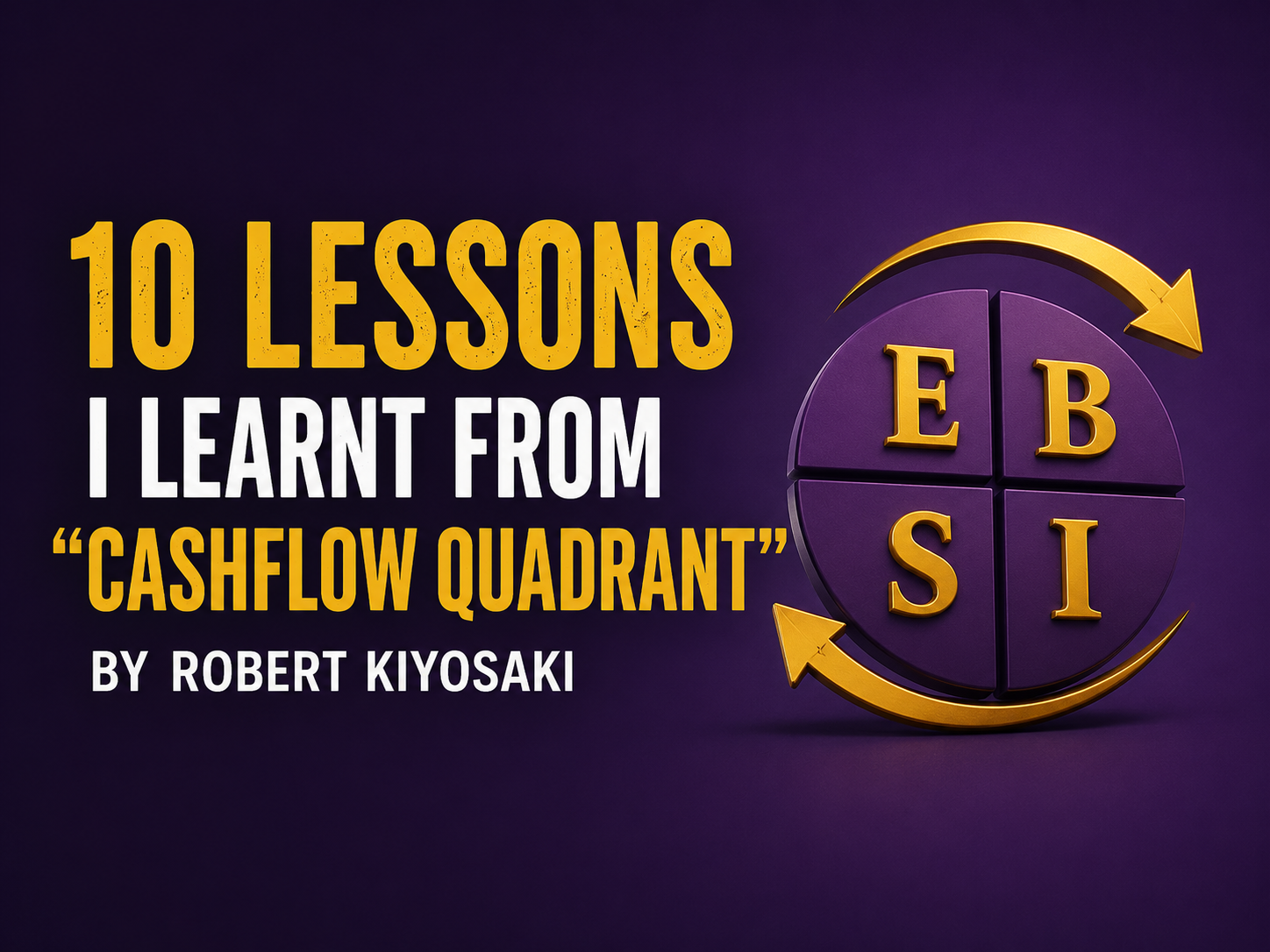
The book explains that people earn money in four different ways, which Kiyosaki calls the Cashflow Quadrant. Understanding these four ways can help you make better financial decisions and work toward financial freedom.
1. The Four Quadrants
1. Employee (E)
Employees work for someone else and receive a salary or wages. Their main concern is usually job security, stable income, and benefits such as health insurance or retirement plans. They prefer certainty and predictability in their financial lives.
Examples include teachers, civil servants, office workers, bank staff, and many corporate employees.
2. Self-Employed (S)
Self-employed people work for themselves. They want independence and like being their own boss. They often believe that if they want something done properly, they must do it themselves.
Examples include doctors, lawyers, consultants, mechanics, hairdressers, plumbers, and small business owners.
The problem is that many self-employed people own a job rather than a business. If they stop working, their income usually stops too.
3. Business Owner (B)
Business owners build systems and hire people to run those systems. Unlike self-employed people, they do not need to be present every day for the business to operate.
For example, the owner of a successful franchise or company may be away for months while the business continues generating income.
According to the author, successful business owners focus on creating systems rather than doing everything themselves. They know how to delegate tasks and lead people effectively.
4. Investor (I)
Investors make money through investments. Instead of working for money, their money works for them. They earn income from assets such as stocks, businesses, bonds, or real estate.
Kiyosaki argues that eventually, anyone who wants lasting wealth must learn how to invest because true wealth comes from assets that continue producing income.
2. The Story of Two Fathers
Throughout the book, Kiyosaki compares lessons from his two father figures:
- His educated father (“poor dad”) had excellent education, a respected career, and job security, but struggled financially and became dependent on employment.
- His rich dad focused on building businesses and investments, gradually gaining more money, more freedom, and more time.
One lesson that deeply affected Kiyosaki was seeing his educated father lose his government career later in life and struggle to adapt to the world of business. Meanwhile, rich dad continued becoming wealthier because he had built businesses and investments that worked for him.
3. Different Mindsets Create Different Results
One of the book’s main messages is that financial success is not only about technical knowledge. It is also about mindset. Different people respond differently to fear, uncertainty, and money.
For example:
- Employees often respond to financial fear by seeking security.
- Self-employed people respond by taking control and relying on themselves.
- Business owners focus on building systems.
- Investors focus on making money work for them.
The author emphasizes that moving from one quadrant to another often requires changing how you think, not just changing jobs.
4. Leadership Is Essential
Kiyosaki explains that successful business owners must know how to work with people and bring out the best in them. Leadership is not about controlling people; it is about inspiring and guiding them.
He argues that technical skills such as accounting, marketing, sales, and management are important, but people skills are equally important for building successful businesses.
5. The Difference Between Owning a Job and Owning a Business
One of the most important ideas in the book is the difference between:
- Owning a job
- Owning a business system
Many people think they own a business when they are actually self-employed. If they stop working, the income stops. A true business continues operating even when the owner is absent.
The author uses a dentist as an example. A dentist may earn a good income, but if the dentist goes on vacation, income usually stops. A business owner, however, can take a vacation while the business continues making money.
6. Systems Matter More Than Products
Many entrepreneurs focus heavily on creating a great product. Kiyosaki argues that a great business system is often more important than a great product.
He uses McDonald’s as an example. Many people can make a better hamburger than McDonald’s, but very few can build a business system as successful as McDonald’s. The strength lies in the system, not necessarily the product itself.
Similarly, he points out that successful companies often win because they have strong systems for production, marketing, training, and distribution.
7. Other People’s Time and Other People’s Money
The author introduces two concepts:
- OPT (Other People’s Time)
- OPM (Other People’s Money)
According to him, wealthy people often build businesses and investments that use the time, talents, and money of many people instead of relying only on their own efforts.
This allows them to earn more while working less directly.
8. Being Rich Is Different from Being Wealthy
A major lesson in the book is that being rich and being wealthy are not the same thing.
A person may earn a large income and still not be wealthy if they spend everything they earn.
According to Kiyosaki, true wealth means having enough assets that generate income to cover your living expenses without requiring you to work.
For example:
- If your monthly expenses are ₦500,000 and your investments generate ₦500,000 or more every month, you have achieved financial independence.
- You no longer depend entirely on a job to survive.
9. Avoid the Lifestyle Trap
The author warns against a common mistake: increasing spending every time income increases. Many people earn more money, then immediately buy bigger houses, newer cars, and take on more debt.
As a result, they become trapped in a cycle where they must keep working harder just to pay their bills.
Instead, he encourages people to use extra income to acquire assets that generate future income.
10. Money Should Work for You
One of the strongest messages throughout the book is that financial freedom comes when your money works for you instead of you always working for money.
The goal is to gradually move from depending entirely on earned income toward owning businesses and investments that produce passive income.
Final Takeaway
The central lesson of Cashflow Quadrant is that financial freedom is achieved by changing how you earn income. Most people spend their lives earning money through jobs or self-employment, but the truly wealthy focus on building businesses and investments that continue generating income without their constant involvement.
The book encourages readers to:
- Understand which quadrant they currently belong to.
- Develop new financial skills and mindsets.
- Build assets instead of liabilities.
- Create systems that can operate without them.
- Invest regularly so that money can eventually work on their behalf.
In simple terms, the book teaches that lasting wealth comes not from working harder, but from building businesses, acquiring assets, and creating income streams that continue even when you are not working.
Share this content:

Related Posts












Post Comment