








Slip of the Tongue: Mistake or the Truth?
Human communication is far more complicated than many people realize. Sometimes people say things they never intended to say. At other times, they accidentally reveal information they were trying very hard to hide. This phenomenon is commonly referred to as a “Slip of the Tongue,” formally known in psychology as a Freudian Slip or parapraxis. These moments often leave people confused, suspicious, embarrassed, or curious because they raise an important question: Was it truly a mistake, or did the person accidentally reveal the truth hidden in their unconscious mind? Consider the following scenarios.
Scenario Number One

A man living peacefully with his wife. One day, while speaking to her, he accidentally called her “Esther” instead of “Jane.” He quickly corrected himself and apologized, claiming it was merely a slip of the tongue. Out of curiosity, his wife asked, “Who is Esther?” He denied anything suspicious and dismissed it as a simple verbal mistake. However, several months later, the wife discovered that Esther was actually her husband’s secret lover. Suddenly, what appeared to be a harmless mistake became a disturbing clue pointing toward hidden truth.
Scenario Number Two

Adams Oshiomhole, a senator and former governor of Edo State, was addressing journalists after the results of an election were announced when he said, “only those who can withstand the pain of rigging should contest in an election,” before quickly correcting himself and saying, “sorry defeat.” Oshiomhole’s slip of the tongue sounded believable to many people because several election observers and opposition figures had already alleged that the election was rigged. As a result, many interpreted the statement as a possible Freudian slip that unintentionally reflected what was already being discussed publicly.
Scenario Number Three

Sheikh Ahmad Abubakar Gumi, a Nigerian Islamic cleric and former military officer, has been widely accused by critics of having links and access to Fulani bandits terrorizing parts of North-West and North-Central Nigeria. These allegations largely stem from his repeated advocacy for amnesty and dialogue with the bandits instead of relying solely on military operations. Additionally, his close associate and personal assistant, Tukur Mamu, was arrested by the Nigerian government over allegations related to terrorism financing and illegal firearm possession. During what appeared to be a religious gathering in a mosque, Gumi, while speaking in Hausa, reportedly said that “most politicians do not care about dialogue; all they want is to go into the bush and kill our warriors,” before quickly correcting himself and saying, “our people.” Because of existing public suspicions and controversies surrounding him, many people viewed the statement as a possible slip of the tongue that unintentionally revealed subconscious sympathy or emotional identification with the armed groups.
Situations like this happen frequently in everyday life. People accidentally mention names, reveal hidden feelings, confuse words, or say things they later regret. These incidents are often dismissed as innocent mistakes. Yet psychologists, especially Sigmund Freud, believed such mistakes are rarely meaningless. According to psychoanalysis, slips of the tongue may reveal hidden desires, suppressed thoughts, emotional conflicts, or truths buried deep within the unconscious mind.
What is Slip of the Tongue (Freudian slip or Parapraxis)?
The concept of the Freudian Slip was introduced by the famous neurologist and founder of psychoanalysis, Sigmund Freud. Freud believed that the human mind operates on different levels. While people are consciously aware of some thoughts and feelings, many other desires, fears, memories, and intentions remain hidden within the unconscious mind. These hidden thoughts do not simply disappear. Instead, they sometimes find indirect ways of expressing themselves.
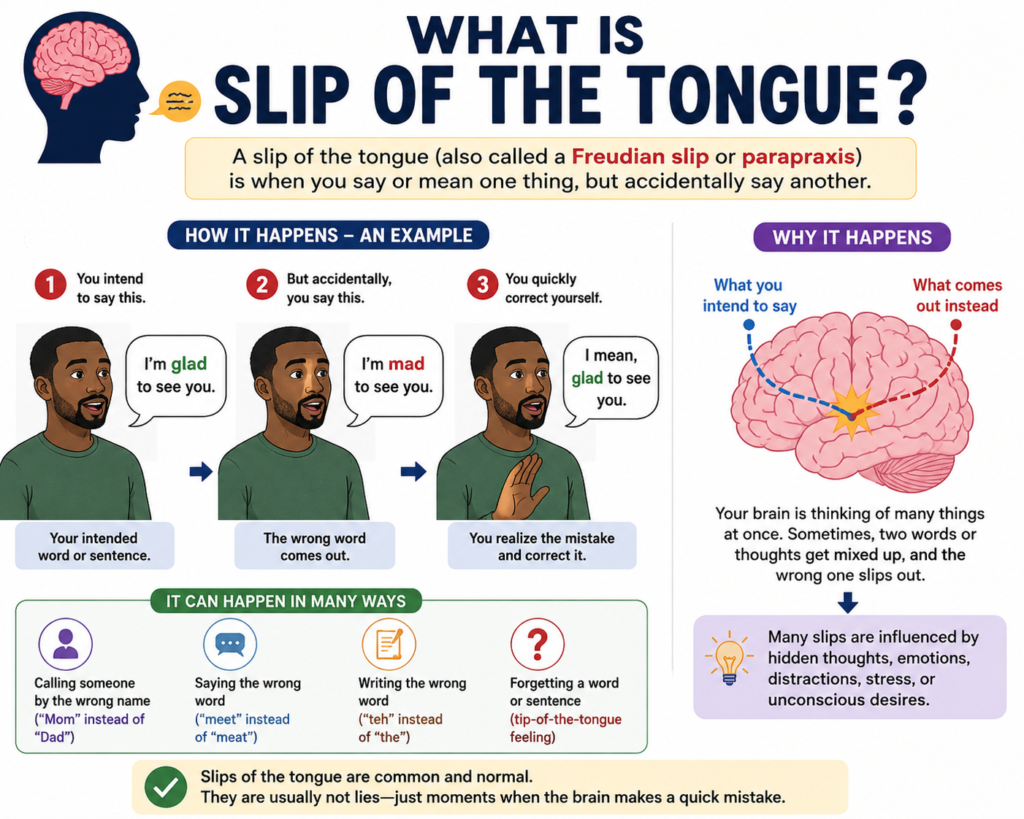
A Freudian Slip occurs when a person unintentionally says, writes, or does something that reveals hidden thoughts or emotions. It may involve calling someone by the wrong name, using an unintended word, forgetting important information, mixing up statements, or accidentally revealing sensitive information. For example, a man intending to say, “I’m glad to be here,” mistakenly says, “I’m mad to be here.” Someone trying to praise another person may accidentally insult them instead. A person may repeatedly forget their partner’s birthday despite remembering everyone else’s important dates. According to Freud, such mistakes are not random accidents. Instead, they are connected to suppressed feelings, unresolved emotions, secret desires, internal conflicts, or hidden truths struggling to emerge.
Why Do Slips of the Tongue Happen?
One important thing to understand is that the human brain processes enormous amounts of information daily. Thoughts, emotions, memories, fears, fantasies, and desires constantly interact inside the mind. Sometimes, especially under emotional stress, distraction, guilt, anxiety, attraction, or pressure, hidden thoughts may accidentally interfere with normal speech.
For example, imagine a man secretly attracted to his coworker. Even if he consciously tries to hide those feelings, his mind still continuously processes thoughts related to her. One day while speaking to his wife, he accidentally calls her by the coworker’s name. He immediately becomes nervous and corrects himself. Although he may claim it was accidental, the mistake likely occurred because that name was occupying emotional space within his mind. This is exactly why Freud argued that slips of the tongue are rarely meaningless. Words do not simply appear from nowhere. The unconscious mind influences speech more than people realizes.
The Unconscious Mind and Hidden Thoughts
Freud believed the unconscious mind stores secret desires, painful memories, suppressed emotions, forbidden fantasies, guilt, unresolved conflicts, and hidden intentions. Even when people try to suppress these thoughts consciously, they do not disappear completely. Instead, they may emerge indirectly through dreams, jokes, body language, emotional reactions, or slips of the tongue.

For instance, a politician publicly claiming loyalty to a political party may accidentally praise the opposition during a speech. A person pretending to be happy in a relationship may jokingly express interest in being single. Someone secretly angry at a friend may accidentally make insulting comments disguised as humor. These moments may reveal what the person truly feels beneath the surface.
Why Slips of the Tongue Usually Happen Within Context
One interesting observation about Freudian slips is that they rarely happen completely outside context. A person does not randomly say words they have never heard before or mention names that hold no meaning to them. Usually, the mistaken word or name is connected to something already existing in their thoughts, experiences, memories, or emotions.
For example, a husband may accidentally call his wife by an ex-girlfriend’s name. A student worried about failure may mistakenly say “fail” instead of “pass.” A guilty employee hiding theft may nervously mention missing money before anyone asks. However, people rarely call their spouse by the name of a random stranger they never met or accidentally mention unfamiliar words without any mental connection. This contextual connection strengthens the argument that slips of the tongue are often psychologically meaningful.
Real-Life Examples of Freudian Slips
Freudian slips occur in everyday life more often than people realize. A woman constantly insisting that she views her male colleague “only as a friend” may accidentally refer to him as “my man” before quickly correcting herself during a conversation. Her slip may indicate emotional attachment she has not fully admitted openly.
An employee secretly frustrated with their boss may say, “I hate—I mean appreciate working here.” The accidental use of the word “hate” may reveal genuine suppressed frustration. During wedding vows, someone may accidentally say another person’s name instead of their partner’s. While this may sometimes result from nervousness, it can also indicate unresolved emotional attachment. A student accused of cheating may quickly say, “I didn’t steal—I mean cheat,” unintentionally revealing connected guilty thoughts.
Are All Slips of the Tongue Hidden Truths?
Although Freud strongly believed slips of the tongue reveal unconscious truth, modern psychology takes a more balanced approach. Not every verbal mistake automatically exposes secret desires or hidden guilt. Sometimes speech errors happen because the brain processes language quickly, people become distracted, fatigue affects concentration, or similar words become confused accidentally.
For example, exhausted parents may accidentally call one child by another child’s name. Teachers may mix up students’ names during stressful classroom situations. Someone multitasking may unintentionally use the wrong word while speaking quickly. Therefore, not every Freudian slip should be treated as absolute proof of hidden truth. However, repeated or emotionally significant slips often deserve attention, especially when they repeatedly involve the same person or later events confirm hidden realities.
Slip of the Tongue in Romantic Relationships

Freudian slips often create the strongest emotional reactions in romantic relationships because they may expose hidden attraction, unresolved feelings, emotional dissatisfaction, or even infidelity. Repeatedly mentioning an ex, confusing names, accidentally revealing affection, or making emotionally revealing jokes can create suspicion and emotional tension between partners.
However, it is important not to jump to conclusions immediately. One accidental mistake alone may not prove cheating or dishonesty. Healthy relationships require communication, observation, emotional intelligence, and evidence rather than paranoia. Still, repeated suspicious slips combined with unusual behavior may indicate deeper emotional issues worth paying attention to.
The Role of Suppressed Desires
Freud believed suppressed desires strongly influence slips of the tongue. Human beings often hide thoughts they consider socially unacceptable, morally wrong, embarrassing, or dangerous. Yet suppressing thoughts does not completely erase them. Instead, they remain active beneath conscious awareness.
For example, a married person secretly attracted to someone else, an employee secretly hating their job, a jealous friend pretending to be supportive, or a politician secretly disagreeing with public statements may unintentionally reveal hidden emotions through verbal mistakes. The unconscious mind continuously influences behavior, emotions, and speech more than most people realize.
Why Freudian Slips Fascinate People
People find slips of the tongue fascinating because humans naturally want to understand hidden intentions. Society often teaches people to hide emotions, suppress desires, control appearances, and avoid revealing uncomfortable truths. Freudian slips appear to momentarily remove that emotional mask.
When someone accidentally says something revealing, listeners often feel that the statement came from somewhere meaningful. They may believe the person accidentally exposed how they truly feel inside. This curiosity explains why people pay close attention to accidental statements during arguments, interviews, romantic relationships, political speeches, and criminal investigations.
Conclusion
Slip of the tongue, also known as Freudian Slip or parapraxis, remains one of the most fascinating concepts in psychology and human behavior. According to Sigmund Freud, these verbal mistakes are not entirely accidental. Instead, they may reveal hidden desires, unconscious thoughts, emotional conflicts, suppressed truths, or secret intentions buried deep within the mind.
Real-life experiences often support this idea. People sometimes accidentally reveal feelings, attractions, guilt, frustrations, or secrets through seemingly harmless mistakes. Words rarely emerge completely without mental connection or emotional meaning. As Freud argued, the unconscious mind continuously influences human behavior, often more than people realize.
However, it is equally important to remain balanced and realistic. Not every verbal mistake automatically exposes secret truth. Fatigue, distraction, stress, memory confusion, and language processing errors can also cause speech mistakes. The key is understanding context, patterns, emotional significance, and surrounding behavior before drawing conclusions.
Ultimately, slips of the tongue remind us that the human mind is complex. Sometimes the truth people try hardest to hide quietly escapes through the very words they never intended to say
Share this content:















Post Comment