Skip to content
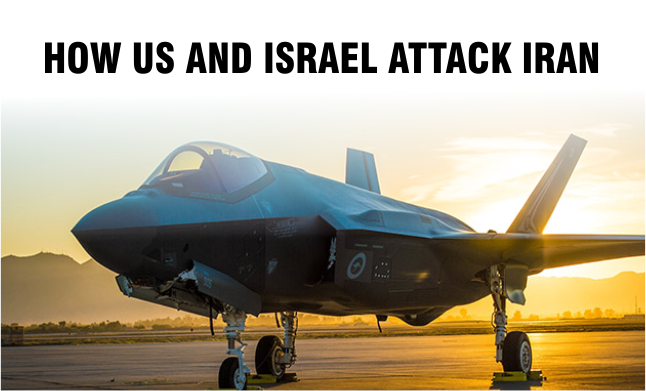
A coordinated preemptive strike reportedly carried out by United States and Israel against Iran has drawn global attention due to the advanced military tactics and synchronized execution involved in the operation.
Coordinated “Time on Target” Strategy
According to emerging reports and military analysis, the operation relied heavily on a tactical concept known as “Time on Target” (TOT)—a strategy designed to ensure that multiple weapons launched from different locations strike their targets at exactly the same moment.
In this case, fighter jets, stealth aircraft, and cruise missiles launched from naval platforms were carefully timed so that attacks from air and sea converged simultaneously. This method reduces the enemy’s reaction time and maximizes operational shock.
Israeli forces reportedly focused on high-level political and leadership targets, including locations linked to Iran’s Supreme Leader, Ali Khamenei, while U.S. forces concentrated on strategic military infrastructure and high-value industrial facilities.
Israel reportedly named its operation “Roar of the Lion,” while the United States referred to its mission as “Epic Fury.”

Key Targets of the Operation
The joint strike reportedly focused on weakening Iran’s military capability and command structure. Major targets included:
- Air defense systems
- Air force and naval bases
- Military command centers and communication stations
- Weapons manufacturing facilities
- Strategic government compounds linked to senior leadership
Military analysts suggest the objective was to disrupt Iran’s operational coordination by striking multiple critical locations simultaneously.

Why Iranian Air Defenses Struggled to Respond
One of the most significant aspects of the operation was the reported use of multi-domain electronic warfare, combining capabilities from space, sea, and air.
Reports indicate that advanced electronic countermeasures temporarily disrupted Iranian radar networks. At the same time, decoy systems—particularly the ADM-160 MALD (Miniature Air-Launched Decoy)—were allegedly deployed to create false radar signatures.
These decoys are designed to mimic the radar appearance of fighter aircraft such as F-15 and F-16 jets, causing air defense systems to track non-existent threats while real stealth aircraft—reportedly including fifth-generation platforms such as F-35 jets—approached undetected.
This layered deception strategy may have significantly reduced Iran’s ability to coordinate an effective early response.
Simultaneous Strikes Across Multiple Locations
Reports suggest the primary objective included a strategic compound believed to be located near the core of Iran’s government infrastructure. Multiple cities and military installations were reportedly targeted at the same time, reinforcing the broader objective of overwhelming Iran’s defensive coordination.

Such simultaneous attacks are often intended to create operational confusion by forcing defensive systems to respond to multiple threats at once.
Iran’s Retaliatory Response
Following the strikes, Iran reportedly launched retaliatory attacks targeting Israeli positions and U.S.-linked military assets across the Middle East, including locations in Qatar, Saudi Arabia, and Bahrain.
Early reports indicate limited casualties, though the full scale of damage and response remains under assessment as tensions continue to escalate across the region.